Wednesday, February 15, 2012

Oral Presentation Part 5

V. Film Language and Representation


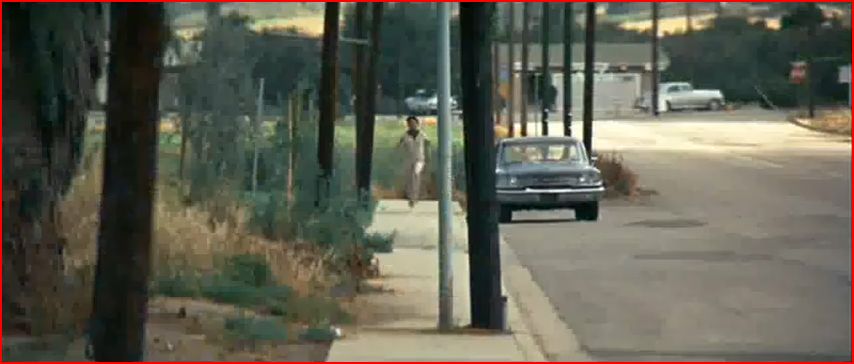
In the last five minutes of The Graduate, we are already knowing of what the conflict is. We see how the notification of Elain's location fuels Benjamin to rush to the wedding chapel and stop the wedding. We see Benjamin as this desperate person who must now reach his destination in time or else. We see these long takes of shots to portray the realism of the situation, which allows the actor to portray his natural feelings with no breaks in continuity. 
The use of this shot was to explain the need for Benjamin to get his destination. This shot makes the situation seem like its being dragged on and that Benjamin is not going to make it in time. This shot also portray realism as the objects around Benjamin are in its natural setting and there is no alteration to the shot or the setting.  We also see how shots like this one allow the audience to feel a bit disgruntled as they want Benjamin to reach his destination in time rather than not make it. 
The lighting in this shots allows the visual of Benjamin's emotions. The fill light was used to soften up the shadows caused by the key light on Benjamin's face, allowing his left side to be somewhat illuminated while the other is a bit darker. This use of lighting allows us to see what is being portrayed by Benjamin and what we are to expect. The use of bland colors gives the situation this gloomy mood, as it relates to the dissatisfaction and sadness that Benjamin is feeling.
In this shot, the use of music gives away this sense of success. As both Benjamin and Elaine smile at each other and look away, the music fades in that matches what they are feeling. The music is somewhat slow and soothing, which also matches what is happening in the shot. The absence of dialogue is appropriate as the audience already knows what is happening in the shot simple by what both the characters are just doing.

In many of these shots, the audience's attention is first directed to Benjamin, as he is the main object in motion in these shots. Many of the shots used are loose, as we see the whole scenery around Benjamin as he is running to the chapel. Many of the shots are naturally lit, allowing the sequence to give it a sense of realism. There isn't much "eye catchers" throughout the extract, as mostly everything in the shots are darkish colors, expect the times where we see the red car or the yellow bus. Throughout this extract, there are very powerful emotions of love and commitment. Benjamin is fully committed to reaching Elaine and saving her for himself. The re-occurring theme of love allows the audience to feel what Benjamin feels for Elaine and how he'll do anything just for her. 

Tuesday, February 14, 2012

Short Film Treatment

Logline: Young teenager tries to overcome accidentally killing his girl friend, and forever lives in the shadow of her death.

Bottles of wine scattered on the table. Teenager looks at his girlfriend as they tip off their shot glasses. Couple shots lead into few more as both teenagers continue drinking. Glasses begin falling off the table as teenagers begin to get really drunk. Baseball bat sits near the table as the teenagers grabs it. Girl friend pretends to throw ball at teenagers. Teenager eventually swings the bat, hitting girlfriend in the head, killing her.

Teenager wakes up from nightmare. Looking at the picture of his girlfriend, gets up and takes anxiety pills. After taking shower and washing up, teenagers gets ready for school. Teenager doesn't concentrate in class and is distraught throughout the day. 

As he returns home, he watches T.V. and does homework. Teenager eventually begins to think about his girlfriend and all their happy moments. Teenager steals on off parents bottle of wine and runs to the room. Drinking the wine in desperation, teenager begins to cry himself to sleep.

Teenager wakes up in the middle of the night. Hearing footsteps outside his room, teenager walks out to see it. He sees a ghost figure of his girl friend. Teenager rushes in joy towards girl friend, but image disappears.

Hearing something upstairs, teenager rushes up the stairs. Teenager sees the ghost of his girl friend on the couch. Again, teenager rushes to ghost, but vanishes. Teenager sits down on couch and begins to sob. As teenager is sobbing, ghost of girl friend begins patting teenagers back. Teenager looks up at ghost, seeing her smile at him. Ghost smiles at teenager and kisses him on fore head. Ghost then vanishes away for good.

Teenager wakes up from dream and looks at the empty side of the bed. Looking at her picture, teenager smiles and looks out the window.

Monday, February 13, 2012

Oral Research Part 1- Genre and Audience

The Graduate (1967) is an American comedy/drama directed by Mike Nichols.  It is based on the 1963 novel The Graduate by Charles Webb, who wrote it shortly after graduating from Williams College. The film was produced by Joseph E. Levine & Lawrence Turman, cinematography by Robert Surtees, and edited by Sam O'Steen. In 1967, Bonnie and Clyde (1967) was an American crime film directed by Arthur Penn was also created in the same time as The Graduate and shares similar themes: romantic complications affect the outcome of a certain individuals life. Nichols created this movie to be the first in its time to display works of "one's desire to find true love through any obstacle" along with a story line that exhibits its unique display of formalism. The Graduate took place in a time of social-rebellion, as time of war and rest began to take its toll on people. The common theme shown in this film is that both the younger and older generation have different perspectives and do not understand each other; Mrs. Robinson represents this older generation while Benjamin represents the new generation. Since colleges were being created in this era of time, these students avoided participating in war by attending these colleges, thus making them the target audience of the film. 

Tuesday, February 7, 2012

Sample Oral Assessment

Sample Oral #1
This presentation offers a detailed analysis in the movie Frankenstein that includes background information of the movie, details of the cast, reference to film terms, its editing techniques, etc. Although the student seems to drag on with the presentation in simply applying his understanding of the summary in his presentation, it provides key analysis into how it applies to the directors intent in the film along with a better understanding to what is being depicted. Throughout the presentation, the student hits mainly all the key points while offering additional information on them. The examiner believed that the "sociocultural context of the film" was limited in analysis, however, it does seem to cover what is to be expected. 22 out of 25 marks seems to be fair for this student, but the student should have receive at most 24 marks due to the fact the all the points were discussed with adequate understanding of the topic with very little limitations on some topics.

Sample Oral #3
This presentation, by far, shows the best understanding of their film and all other concepts associated, thus giving it one of the highest marks. The student exceptionally depicts the film's summary with in detail analysis, the camera techniques along with it's movements, editing styles, music, directors intent, etc. Although the students spends about the minimum time on each topic, their is an exceptional amount of detailed analysis that gives a clear understanding of the topic along with a good transition from topic to topic. Also, the student provides clear use of film terms that add to the student's knowledge of the film of its aspects. Unlike other orals, the sociocultural context of the film is clear explained with good reference to the film which gave it the marks it deserved. 23 out of 25 marks is well deserving of the oral because every aspect of what was to be expected was covered to the highest degree, with some lack in a specific topic that didn't really affect the student's overall marks grade.

Wednesday, January 25, 2012

Blog: Genre Study Chart

Genre: Post-Apocalyptic


Typical Plots: Characters are forced to survive the new elements that affect their chances of survival. These characters have to do whatever is necessary to ensure that they survive. This road to survival is extremely hard as the new environment they are placed in will change their lives forever.

Typical Situations: Characters are faced with abominations of nature. The world they live in is no longer the same and not only is that a problem, but resources are now extremely limited. With family and friends gone as well, anything left that is precious to you is literally all that is going for you.

Typical Characters: Usually male characters are present in these type of films as they are more likely to survive these new bound elements. Women may be present, but rarely are they usually the main characters of the film.

Typical Body Language: The characters are usually somewhat vicious as their want to survive in life. This new environment contributes to this type of person as they usually are more focused on surviving and ensuring that they don't fall victim to everyone else's fate.

Typical Dress: Characters usually have worn out, faded clothes. This is usually because their is a very limited amount of supplies, which means whatever is available is available. These clothes would usually be used very often as it may be the only source of clothing.


Genre: Stoner Comedies


Typical Plots: Characters usually face one problem: not enough drugs. Drugs add on to the comedic tone of the movie, as the characters venture on a journey to enjoying life. Life however, is not that enjoyable, as their is always some kind of conflict in the way of it.

Typical Situations: Characters usually face some sort of conflict; usually there is someone that they owe for the drugs or are constantly being harassed by this person. The only way out of this conflict is to literally fight them off while being stoned.

Typical Characters: Characters are usually always acting stupid and inappropriate in many situations. They will usually do whatever seems necessary in ensuring that the audience gets a good laugh. 

Typical Body Language: Character is usually sluggish and wants to just be lazy. This is mainly due to the fact that these drugs affect their senses and the way they act. This adds onto the comedic tone of the film.

Typical Dress: Goofy, sloppy looking characters. They dress like how they literally portray their character like. This adds on to how they will be presumed as, and gives the audience the sense that this person is just a complete idiot.

Sunday, January 22, 2012

Blog: Ideology In Film

What is ideology and how can it be implicit vs. explicit?
"Ideology was a term used in political and economic debate to describe a set of beliefs or principles e.g. socialism or capitalism."  This means that ideology is used to describe ones beliefs into a particular subject. This relates to film because film uses these beliefs/principles in media text to communicate to the viewer. Ideology can be implicit because it's  "debatable meanings of a film, possibly beyond the conscious intentions of the filmmaker, that require analysis and a reasoned argument." This means that some films require deeper analysis than what the film maker intended to better understand the film's underlying meaning.

Ideology and Expectations
Actors like Sam Worthington  exemplify this character that has leadership qualities while maintaining this strong, dedicated to justice type of person. This is shown in movies like Avatar, Terminator Salvation, and Clash of the Titans. In all of these movies, Worthington is able to embody all of these qualities. In Avatar, he is able to live two lives; one of a human and one of the Navi. He eventually rises to be the one who leads the Navi to war against the invading humans and brings them to victory. In Terminator Salvation, although he his part of the terminator side, his main intentions are finding out what his true intentions are in his rebirth. He eventually figures out that his main reason for his rebirth was to aid the resistance in fighting against the robots, while ultimately finding Kyle Reese, the key to their victory. He ends up saving John Connor from death by giving him his heart to live. Lastly, in Clash of the Titans, Worthington embodies this warrior who must face all of these obstacles in order to defy the gods. He kills all of these monstrosities while still being able to live, ultimately finding out that his father is a God and that he is to join them. He denies the invitation in order to stay back and defend his fellow people from future threats. All of these movies show how Worthington ideology lies within the heroic type character, one that he has chosen in many movies and has successfully pulled off.  

Personal Ideologies and the Enjoyment of Film
Marshal Mathers, also known as Eminem, is a famous rapper who took on a difficult role in 8 Mile. What I like about Eminem is that he was able to take on this role of a struggling rapper trying to make it out of Detroit. This movie was a basic story of Eminem's upbringing to become a rapper, and how he had to go through all of these obstacles in order to make his name known. What I mainly like is that he was able to seem naturally emotional in this movie and truly act as if it were real life. Curtis Hanson made the movie to simply analyze the main characters struggles in life, and displayed it magnificently by showing how he had to go through all of these struggles and hardships to get his name out there.  This makes the audience not only sympathize for what he is going through, but also get them emotionally attached to the movie. Hanson intentially did this to ensure that the audience not only understand what it's like to go through all these struggles, but to also feel the main character's pain. By doing this, this leaves the audience in admiration for the main character's determination to reach success, which was Hanson's overall success in the end.

Changing Ideologies
Simple, as time passes, so does our beliefs in a certain thing. When a film is created in a specific time period, it embodies everything around it, such as certain trends, styles, etc. Every decade or so, movies begin to ultimately change. In this era of film, it mainly focuses on special effects and entering the "unknown", rather than simply focusing on the story of a film as once done back in the 1900's. This is mainly due to our growing in new technologies, which help enhance the overall image of a story and make it seem even more realistic.

Ideology and the "Effects" Debate
In this era of film, many films do affect the way I am as a person. With all of these new movies that display such things that we would never see in real life simply amaze me. Transformers, for example, was one of those movies that simply amazed me. Vehicles transforming in giant robots, buildings being destroyed, advanced weaponry and tanks used in combat, all of these things that never are seen in real life are shown in this movie, and makes my imagination just run wild. This film doesn't really affect my behavior, as do others, simply because I understand that things like this may not ever happen, and that a movie is just a movie used to entertain people.


Ideology and Realism
"Some of the ideological assumptions which we make about film are related to whether we believe that the fictional world of a film is real." This is what is know as suspension of disbelief. What this means is that we do not judge whether some is real or not in films, rather we just enjoy it. In movies like Predator, although we know that this film displays things would never happen in the real world, we the audience just simply enjoy it and look at it in awe. This movie shows an alien that entered Earth and kills human. Although we the audience know that things like this may not happen, we admire how the idea of fighting against aliens may look like.


Ideology & ownership
Finances do affect the ideology of a film. A director may have an idea of how a movie may look like, but finances needed to produce a movie like that may restrict it's overall idea. Not only that, it may not come out as intended and sufficiently display it's overall message. When a movie is published in movie theaters, the overall income and satisfaction of the viewer determine whether the movie is a success or not.

Thursday, January 12, 2012

Blog- Writing About Film

What are the 5 kinds of film writing described in the article and what are the key details of each.
The first kind of film writing is Formal Analysis. This requires that the viewer breaks the film down into its component parts and discusses how those parts contribute to the whole. This means that each part of a film is broken down into smaller components in order to better understand each component better. By doing this, you not only acquire a better understanding of each component, but you being to understand the overall idea of what the film is conveying. The second kind of film writing is Film History. This concept refers to how films reflect history, influence it, and have it. It also reflects the values and ideas of the culture that produce it.  War films, for example, greatly reflect what film history is. Pearl Harbor is a good example of what film history is, as this movie portrays what events took place during this time period. This movie reflects history as it depicts what actually happened in the best way possible. Ideological Papers is the third kind of film writing. This refers to how a movie promotes certain values to manipulate our feelings about a set of values. This means that a movie attempts to make the audience feel a certain way to what the movie is trying to show. This may make the audience feel more patriotic for their country, as shown in the movie Independence Day. The fourth term is Cultural Studies/National Cinemas. This refers to how films reflect the cultures and nations in which they are produced. For example, other countries produce films that may seem different to us; a french person may find a french comedy to be funny, while we see it as normal. The last term of film writing is the Discussion of the Auteur. This refers to a film as the product of a single person and his vision. In many cases, that person may be the director. This refers to how we see a certain film to be a "well known" film. This is widely practiced as it helps us understand the common themes and aesthetic decisions in films by the same direct

What does "Annotating a Film Sequence" involve and what are it's benefits?
This refers to how one takes a particular shot and takes notes on it, which may also be know as to annotate a shot sequence or scene. To annotate a scene is to label each shot in a sequence. For example, when you see a film, there are various shot techniques used to make the film more interesting. One may look at these different shots and annotate them as a better way to learn of what the shot as created and what it has captured.  This makes us understand how the director crafted his/her film and why the film has a certain effect on the audience.

What does the author imply when she says to "Think Beyond the Frame?"
To think beyond a frame is to think about the what the background of it is. This includes questions such as who made the film, what is the production history of the film, etc. By doing this, you not only get a better understanding of the film, but you also see the directors intent in his film as a whole. Also, when you think beyond the frame, you also get a better understanding as  to what deeper meaning a frame has rather than what it merely shows. 

Monday, December 19, 2011

Blog: 5 Most Valuable Minutes- Research Practice

                                                                     06:06-12:50
I chose the very beginning of the film because it really characterizes the person that Travis Bickle is. It also shows how his everyday life seems to just be a living hell, as he lives and works on the unforgiving streets of New York. Throughout the film, it is visible that this environment really shapes who Travis Bickle is as a person, and how this everyday environment really affects him.

The beginning of the film displays Travis's life. It shows the job he works in, how he is a desperate person for love, and how he really doesn't know how to apply himself to formally greet people. In this shot, we see Travis driving what seems to be a man with his wife. We can see that Travis uncomfortably doesn't like what he does for a living, and doesn't appreciate how others treat him. The darkish tint to the shot also gives that gloomy appeal; this makes us, the audience, feel like Travis is living in an uncomfortable environment. This relates to the plot throughout the film because Travis has to drive a bunch of people that show him no respect, and he's force to live with it. This is a probable explanation as to why he is the kind of person that he currently is. This also show's the director's intent to show how Travis will eventually develop as a character. By showing these kind of scenes, it shows the worst of Travis, and how he's going to have to eventually develop to become a better person.

This scene also characterizes who Travis is as a person. Him drinking in public shows him as a person who doesn't abide by the usual standards of being normal. This also shows how he has a drinking problem; this is significant because it shows that he's weak. By drinking in public, it also shows that he's trying to drink away his problems, and he doesn't care what happens to him. The director's intent here, as previously state above, is that he wants to establish what kind of person Travis is, and how this characterization of him plays out throughout the film. 

These two scenes show Travis' Bickle's life without a female. In the top scene, it shows how he sadly tries to flirt with the cashier with the hope of getting her number, but eventually gets shut down. This also shows how he is a desperate person; he flirts with a person that he doesn't even know, and hopes that she'll respond to him with interest. This shows how the director wanted to depict Travis as this person that has to get what he wants in order to satisfy his needs. 

In the bottom scene, it shows how Travis is a even bigger desperate person. He watches porno's as a way to contemplate for his sorrow's in life. This also shows his desperate as he really wants to find love. These two scenes really show what kind of person Travis really is. He really wants to make an effort at finding love, however, he is inexperience in it, and has to result to watching porno's to make up for it.


This scene is a turning point in the begging of the story. Travis finally seems to found a women that could possibly satisfy what he is looking for. Once again, however, his inexperience as to how to approach a women properly is still not present. This makes him out a a creeper, and not suitable for the women. This shows the director's intent of really trying to show how this women would be his driving force to attempt to get better for a period of time. This is a big part of the film because Travis really tries to better himself to really impress this women, however, this is not evident later on in the film. This shot also shows how the lady works to support the future president. This foreshadows what Travis has to do in order to impress this woman.

Thursday, December 15, 2011

Short Film Portfolio/Critique

A. Rationale:
The film that me and my group made was a simple short film on our main character's life without his mother around. We chose this type of movie in an attempt to really capture our audience and engulf them in the main character's compelling story. We thought this was a good idea because we thought that by making the main character as real as possible along with good flashbacks, it would really make the short film believable. Also, we really wanted to make a film that broke the fourth wall, and this hasn't really been done by my fellow colleagues.

B: Commentary: 
My area in the film was mainly cinematographer and editor, along with being the director at times. I chose to be the cinematographer and editor mainly because I was very familiar with these roles, and the director just came along naturally. Usually with these many roles there would be difficulties, but I surprisingly rose to the task and made very few mistakes. The only troubles I had was ensuring that I had proper lighting for many of my shots as we shot a lot inside and it was usually dark.


I also had trouble maintaining continuity throughout the film I wanted pure perfection in the film. I fixed these problems by ultimately stopping the filming process, and fixing up everything. I made sure that we had natural lighting from the sun by making sure that light came into the house, and I made sure that I took as many possible takes on a scene as possible. Problems that arose throughout the film was actually coming out with the concept of the film as a whole. We had to usually improvise a lot of the film on the spot, however, it still came out good. We got a lot of pretty unique shots, such as the one's in the beginning, that set the basic location of the film.


We only had three people all together on the film production, with usually one person just lagging off, but we still do good. One main problem we had was deciding whether to keep the entire process where the main character dresses up to leave, or just skip to him leaving his house. We ultimately ended up just keeping the dress scene, however, it was a mistake as it was deemed "unnecessary" by our fellow colleagues. Although we were shorts on personnel for the shoot, we still was able to keep that one person who never helped useful by making sure that he worked on our film site. Overall, we thought that the film was a good success. Our initial thought was tat it would be a failure because everything was really falling together, but surprisingly it did. A lot of the credit has to go to Justin Pieraldi, for stepping up to the task and really acting from the heart. 


We thought that the film also had some pretty good cinematography. Many of our shots, although not that noticeable, took a lot of time as we tried to set up each shot with good lighting and fluidity. We also tried to ensure that mostly every shot had purpose; the flashbacks ensured that sense of sadness, and this was one of our main goals in this project. These flashbacks basically were the backbone for our project as it really allowed the audience to feel for the main character.

We also that we had really good editing. Throughout the film, it was visible that there was clear continuity. This was one of our main goals from the beginning of the film. By maintaining this continuity, it allowed our film to seem really fluent and really kept that sense of realism. Also, this editing really did capture great continuity as it matched well with the flashbacks. Whenever the main character said something with significance to the past, a flashback was included to show what he was talking about, and this couldn't be done without such good editing.

Our sound came out pretty decent. We had some minimal trouble making sure that the mic was kept steady to prevent that scrunchy sound, however, that was still visibly heard. We made sure that the mic was as close to the main character as possible to ensure that everything he said was understandable. The sound quality still came out exceptional as it played it's role in ensuring that it flowed with the film. 

The music choice we used also worked out very well. It set the stage for making the sentimental scenes really stand out. The music we used was to ensure that it really brought out the sincerity of the main character and that it would make the audience believe his sincerity. It took a lot of research to find the perfect song, but it was worth it when we found ours.

C: Supporting Evidence:


Monday, December 12, 2011

Blog Response- Article- Intensified Continuity

According to David Bordell, explain how and why continuity has intensified in Hollywood cinema. Also consider whether anything has been lost with this change.

David Bordell explains that Hollywood Cinema has intensified over the years. Film makers have deterred themselves slowly from the use of wide angle shots and transferred over to a more fast pace cutting. Also, film makers now a days now use narrow lenses rather than the standard wide lens.

"Between 1930 and 1960, most Hollywood feature films, of whatever length, contained between 300 and 700 shots, so the average shot length hovered around eight to eleven seconds." This shows that each shot was usually a long length shot that stood still. In the mid 1960's many filmmakers began to experiment with faster cutting. Filmmakers began to edit their films more faster to make the film seem more interesting rather than showing one long continuous shot. In the 1980's, the tempo had continue to pick up, however, average shot lengths began to vanish. ASL's in movies began to now reach an average of four to five seconds. This shows how filmmakers began to go away from ASL's, and move toward more faster shots. 

Faster cutting of shots had become a 'must' for films. Shot lengths went to the extreme of lasting 1.5 seconds per shot. "No film is one long sequence." This shows that films have gone away from the traditional ASL, and now have become more fast pace. 

"From the 1930's well into the 1960's, directors often played out stretches of scenes in a plan americain, which cut off actors at the knee or mid-thigh level." In recent decades, filmmakers have been inclined to build scenes largely out of singles. These singles allow the director to vary the scene's pace in editing. When widescreen process were introduced, filmmakers often felt obliged to rely on long shots and medium shots. This shows that throughout the years, the style of shots had continually changed and filmmakers emphasis on it increased.

"Today's camera movements are ostentatious extensions of the camera mobility generalized during the 1930's."  This means that camera movements are now used to attract the audience's attention rather than focus on the main meaning of the shot. Today's camera use the "push in" to show the emotion displayed in a person's face. Push in's underscore a moment of realization and build continuous tension. Today's camera work has further pushed itself from the classical Hollywood styles of film, creating a new era of film making.


Friday, December 9, 2011

Blog Response- The American Anti-Hero

What historical factors influenced the rise of the American Anti-Hero in cinema and how does this hero contradict the Classic Hollywood Ideology.

The Anit-Hero became popular between 1945 and 1980 after World War II.  According to Wikipedia, "An anti-hero in today's books and films will perform acts generally deemed 'heroic', but will do so with methods, manners, or intentions that may not be heroic" This describes them as heroes that aren't really smiled upon. After the war, America was looking for a new type of Hero and they wanted this hero to be rebellious to their society. America also wanted this heroes to represent what life was really about, and to reflect the human spirit that everybody embodied. From 1945 to 1980, there was mass amounts of anti-heroes in American movies. "Within the American cinematic gestalt, we are continually offered portrayals of the individual redemptive journey. Filmmakers repeatedly portray versions of the hero and anti-hero. These figures have their roots in age-old mythologicaland religious characters..." (Fitch 1). This shows that filmmakers made these attempts at portraying this "hero" as what the American people had wanted. "The anti-hero gained popularity in the 1940s and 1950s, probably due to the cynicism during and following World War II."

"The anti-hero was daring the audience to relate to doing wrong or being wrong even for the wrong reasons. " We can personally relate to the anti-hero because we too make mistakes and do wrong doings. These characters gave the audience a sense of something tangible lost or gained, which gets us, the audience, thinking what these anti-heroes go through. The anti-hero can also be described as "rebellious", as he prefers conflict rather than comfort, which shows his true intents as this hero figure. Within Classical films, the hero is usually the one that is courageous and always looking out for others, but that contradicts what a anti-hero is. The anti-hero goes against the Classic Hollywood Ideology by defying this stereotype that all hero's do good as it is the right thing to do. The anti-hero looks out for themselves and fight off authority figures simply for reasons unknown. Although this isn't what the audience is typically looking forward to when seeing a film with the average hero, it creates a sense of something new rather then having the audience already know what type of person this hero is.

Thursday, December 8, 2011

Blog- Advanced Editing Notes- Overview/Classical Paradigm

1. How would describe the difference in camera work: composition, angle, movement?
In the "Arrival of the Train" and the "Damsel in Distress", there are major differences that are clearly shown. In the "Arrival of the Train", there is only one whole continuous shot, while the actors in the movie just move around the scene. Although it is a somewhat unique shot as it shows the train at an angle, it is too long, making the whole entire shot seem boring and simply useless. In the "Damsel in Distress", there were a variety of shots that made the film seem really intense. There was a lot of PoV shots, reaction shots, such as when the man was tying up the women and noticing that the train was about to arrive, and Direction Match Shots, such as when the women was constantly looking back to see where the train was. These shots added together make the film seem more interesting as it makes the audience more interested in the film.

2. How would describe the differences in the edit?
In the "Arrival of the Train", there was absolutely no cutting at all, and there was just one long continuous shot. This makes the film seem really boring, although there seems to have a lot of movement in it. In the "Damsel in Distress", there is a lot of quick cuts, that add on to the intensity of the film. This gets the audience more into the film, rather then looking at once long, continuous shot. 

3. How would describe the characteristics of the story being told/narrative?
In the "Arrival of the Train", the people in the shot seem to really gitty and rushed. However, there wasn't much emotion displayed, as we couldn't really see what the people were feeling. Also, we, the audience, seem to want more out of a shot, rather than just simply stating the title of the film. In the "Damsel in Distress", we knew what was happening. We knew that the man was the evil mastermind at hand, and the lady was the one in trouble that needed to be saved. The film uses excellent shots, such as close ups in necessary moments, to see what the character is feeling. Also, we see how the evil mastermind acts, showing that he truly is the evil person in the film.

Blog: Advanced Editing Notes: 3. Soviet Montage and 4. Realism

3. Soviet Montage and Formalism
a. What was Pudovkin's concept of constructive editing and how did it manifest itself on film?
Pudovkin insisted that each shot should make a new point. He believed that each shot created new meanings to itself. He believed that riffith's close ups were too intrusive to the actor/actress, which showed no meaning to the shot. The way Pudvokin put close ups together was in a way to create meaning, and stating that long shots were too far from reality. An example of this is when a there was a close up of this man, then it cut to a close up of this bowl of soup, then back to the man, show his emotions and his need to eat the soup.
b. What was the Kuleshov effect and give me an example of how is it used in today's film's?
Kuleshov believed shots were linked together framentarly through details to produce a unified action. The Kuleshov Effect shows that the emotion is produced not by the actor’s performance, but by the juxtapositions. The viewer creates the emotional meaning, once the appropriate objects have been put together by the filmmaker. 
c. What was Eisensteinian Montage and how does it work in the "Odessa Step" sequence?
Eisenstein believed life was about constant change and this dialectical of contrasting opposites, because all phenomena are in a state of becoming. Eisenstein also believed art of film was in the edit, that each shot must be incomplete, contributory rather than self-contained, but not too linked.  Eisensteinian used this technique in the Odessa Step. Critics of Eisenstein argued that his films lacked a sense of realism. They also guided the audience too much. 


4. Andre Bazin and Realism
a. What were Andre Bazin's frustrations with Classical and Formalistic film making?
Bazin claimed that he was not a film maker. Bazin was responsible for creating an approach to analyzing a the body of a Director's work in order to discern patterns in style and themes. He believed that editing could destroy the effectiveness of a scene. Distortions in using formalist techniques, especially thematic ediing, can violate the complexities of reality. Formalists were egocentric and manipulative.
b. What do Realist filmmakers strive for in their work?
Realism in film is accomplished by using long shots, wide screen, lengthy takes, deep focus, panning, craning, tilting, or tracking rather than cutting to individual shots.  Realist filmakers strive to ensure that each shot was as realistic as possible, and that it flowed smoothly, rather then doing unnecessary cutting to a shot. By not following these guidelines, realist filmmakers cannot create this sense of reality. 
c. What techniques to realists use in their film making?
Realism in film is accomplished by using long shots, wide screen, lengthy takes, deep focus, panning, craning, tilting, or tracking rather than cutting to individual shots.  Details within a shot are presented more democratically, without the special attention a close-up inevitably confers. 

Wednesday, November 16, 2011

Trailer Review - 8 Mile

The trailer I chose to do for my review is 8 Mile. Although it doesn't have great cinematography, it makes up for it with a powerful story line. 8 Mile is about a wanna rapper who has to go through the obstacles placed in front of him to reach his dream of becoming a successful rapper. He has to go through the harshness of the environment that he lives in, the threat of losing his job, not being able to win a rap battle to gain street credit, etc. These obstacles  not only make it difficult for the main character to succeed, but also push him farther from his dream. This trailer shows snippets of what the main characters has to go through on a daily basis in order to get closer to reaching his dream, while also showing the difficulties of life that he has to also endure a lot.

Like many other movies, this one establishes its narrative by showing the audience what the main character's life is like and what they have to go through in their everyday lives. As in relation to 8 Mile, we see B-Rabbit's life as harsh and really gloomy, however, must live in this environment until he flourishes out of it. In the trailer, it establishes how harsh life is for the main character, along with showing his environment and how it plays a role in deterring him from reaching his goal. Also, it shows the basic plot line; we see him struggling to reach his goal, and how it really affects him along with his mom and daughter. Throughout the trailer, we see tiny glimpses that hint us towards what we think of, such as what life experiences are like and what significant events alter the way he is.

 The cinematography, throughout the trailer, was mostly all the same, yet it was still able to display what the story was about. Many of the shots had a dark tint to it, symbolizing that his environment is harsh and dull. These shots are able to communicate to the audience that the main character lives in a difficult environment and has to endure it in order to reach his dream. Also, many of the shots seem simplistic as it only depicts what the actors are talking about, but the background and their surroundings also add onto the constant harsh tone that is constantly shown. Also, there are many shots in the trailer that show what the main character is experiences; we see him either as scared, confident, nervous, anxious, etc.


The editing throughout the trailer is pretty unique. There is a lot of face pace cuts that show the intensity of the story line, along with words that summarize what each shot is about. The face pace shots really catch the attention of the audience, while also making the movie seem like a "must see". The words that pop up state what the main character is going through in his situation, and is really interesting in how it really has a nice touch to the film.


The sound was crucial in bringing out the film as a success. Throughout the film, the main character is rapping, either in a rap battle, with his friends, etc. There are also instances where there is a altercation between two forces, such as the main character and his opposing enemies. The sounds of gunshots, people fighting, the grunts, all add into the film's main intent.

Monday, October 3, 2011

Run Lola Run Presos


I. Interpretation of the film as it related to your assigned section and use of film language.
My interpretation of the film was vague and somewhat weak. The analysis I did wasn't there because I was too nervous and couldn't remember it. My assigned section was the plot, however, I literally told the plot without talking about the underlying meaning of it. I used little to no film language that didn't really demonstrate my knowledge of the topic.

II. Strengths of your presentation
I was able to talk about the plot with some analysis that somewhat informed the audience of the meaning of certain things. I was able to describe the main parts in the plot and somewhat analyze the author's intent within it.

III. Challenges and Areas for Improvement
Major challenges I faced was the oral presentation and analysis itself. I was prepared to analyze the plot, but I froze when I went up to present. My plot analysis, as said before, was vague and weak. I need to work on my confidence in order to fully talk about my points of analysis. I also need to stop reading off the slides as it tends to show that I'm weak in certain areas of the film. If I can improve on these requirements, I'll be better off in presenting certain parts of film.

Friday, September 30, 2011

Short Film Treatment

Logline: Jacob owes money to a loan shark. Loan shark captures his girl friend. Jacob is given a time allotted to get the money or his girl friend will be killed.


Beer cans on the table, trash on the floor and clothes hanging on the couch. Man is still asleep with despair.
He dreams of his girlfriend being taken away from him and receiving the threat of her death.
Man awakens from dream sad and depressed.
Man thinks of how he must get the money to pay off the loan shark.
He decided to rob his neighbor's house.
Man breaks into his neighbor house.
He is able to break open the bank and steal the money.
Neighbor opens the front door just as man is about to open it.
Man is forced to put neighbor to sleep out of panic.
Man calls loan shark and tells him that he has the money.
Loan shark tells man to meet him at his house in the remaining time left or else.
Man runs off to meet Loan shark.
Man makes it to the house.
Girlfriends voice is behind the closet door.
Loan shark assures man that he'll give her to him for the money.
Man gives Loan shark the money and opens the door.
Girlfriend is lying in the chair, wrapped in rope, with tape recorder next to her.
Girlfriend was already killed.
Man looks back at Loan shark.
Man is shot.
Man wakes up from dream.
Girlfriend comforts him and tells him to go back to sleep.

Monday, September 12, 2011

Volleyball Segment Critique

I basically came up with this idea because I thought it would be interesting to do a segment on something I probably would never want to do. I was able to interview the volleyball players I knew, such as Anissa and Gabby, and they were able to give some pretty good responses to our questions. Our questions were somewhat direct as to the individual itself, but somewhat general as to the team as a whole. I envisioned there to be many intense shots that would accompany the music's pace and that the b-roll for the interviews would match what was said exactly.

For the interviews, I basically just chose the upper spirit court and the front of the school. I thought that by keeping it simple, it would ensure the simplicity of the film but show intensity. I think the b-roll was good. There are a lot of shots that look up to the subjects and many of the b-roll shots accompany what the people say in their interview well. We had a lot of trouble with the positioning of the people because we wither placed them with too much headroom or in the direct middle of the shot. Many of the shots, such as the b-roll shots, were smooth, such as there was no shaking of the camera and their was no focus problems. There was only one problem we had with lighting and that was during the b-roll when I tried to focus on the players but weirdly it got dark and I was forced to zoom out to regain the light. The audio in the interview came out as expected with little to no errors.


We didn't believe that a voice-over in the beginning was necessary because we let the intensity of the screen shots and b-roll explain everything. Out segment was pretty much informative because their was information about their team, their expectations, and how they operate their practice. We only used a voice-over in the very end as a way of ending off the piece on a suttle tone. I wanted to people to remember our piece with that "wow" feeling mainly because of our opening's quick pace shots.


The interviews and the b-roll match very well. Whenever a person talked about a certain thing, there was a shot of their practice that supported their saying. We used basic title sequences from live type with the Capuchino colors. In the beginning, we used screenshots of the players to build up the viewers anticipation, then added b-roll of their practice that was also a montage of shots. In some of the interviews, the people said some interesting things but we couldn't find any b-roll to accompany it so the interview seemed somewhat long. Throughout the segment, their was no continuity errors and it seemed very fluent with the interviews and b-roll.


I honestly loved the beginning of the segment. The building of anticipation, in my opinion, was the only good part of the segment and the b-roll that accompanied it was very exceptional. If I had more time, I would redo all the interviews and ensure that it would actually look like interviews. After doing this segment, I realized that I need to review my notes on how to position people in interviews and also to ensure that the lighting in my b-roll is not too dark.

Sunday, September 11, 2011

Character In Time

This picture of Obama explains a lot about time. All over Obama's body are things he has to deal with, such as the Haiti disaster and the Iraq war. Within his 4 year term, he's expected to solve all of these issues and bring the U.S. back to its feet politically, economically, and socially. As portrayed, Obama's doesn't have enough time to solve all of these issues and it will be a struggle for time. The emotion in his eyes show that their is no hope of accomplishing this or even defeat. His hand on his mouth may mean that it will be too difficult to accomplish this. The words all over his body vary from small to large, meaning minor to major crisis’s. As shown, there are a lot of major crisis’s that will need more than 4 years to solve, not including the minor ones. Overall, this image displays how Obama has to deal with these difficult problems in order to ensure that the U.S. stays a float.